
S. Priya Natarajan: Turning a Broken Educational Journey into a Mission to Empower Others
S. Priya Natarajan’s journey is a remarkable example of how personal adversity can become the foundation for a larger mission of education, empowerment and social service. At the age of 16, while studying in Class 10, Priya’s education was abruptly interrupted when she was forced into marriage. At a stage of life when young people are generally encouraged to dream about higher education, careers and the future, Priya was instead confronted with responsibilities and circumstances that threatened to end her academic aspirations. Yet, the interruption did not become the conclusion of her educational journey. With determination and persistence, she eventually returned to education, acquired multiple qualifications, prepared for competitive examinations, and
ultimately established Avvaiyar IAS Academy in 2022. Today, she is recognised as an educator, founder, motivational speaker and social service pioneer, working to make educational opportunities more accessible to students and aspirants from disadvantaged backgrounds. Her story is particularly significant because her commitment to education is not based merely on professional experience. It has emerged directly from her own struggle to obtain an education. Born into a farming family, Priya grew up in circumstances where financial resources were limited. Her parents owned two acres of agricultural land, and during school holidays she worked as a farm labourer to support her family’s modest income. These experiences gave her an early understanding of economic hardship and the challenges faced by rural families. Despite those difficulties, she wanted to pursue higher education and create an independent future. Her aspirations were disrupted when she was married at 16 while still in Class 10. However, Priya did not allow the situation to permanently determine her future. Determined to continue studying, she left her home in Padalur and enrolled in a government-aided school in Perambalur, where she
stayed in a hostel and completed Class 11. This decision marked an important turning point. It demonstrated that, even after experiencing a major interruption, she continued to regard education as an essential part of her life. The circumstances after marriage remained challenging. Her in-laws were not supportive of her educational aspirations, but with the support of her husband, Priya pursued further studies through distance education. She continued learning while simultaneously handling family responsibilities and working full-time to support herself financially. Her academic progress eventually led to several qualifications, including a Master of Arts, Master of Education, Post Graduate Diploma in Yoga and Post Graduate Diploma in Computer Applications. Alongside her studies and employment, she began preparing for government competitive examinations. Her determination eventually resulted in success in several examinations, including TNPSC Group I, Group IIA and Group IV, as well as Sub-Inspector and Police Constable examinations. She also qualified in TNTET Paper II in 2026. These achievements demonstrated her ability to compete successfully despite the obstacles she had faced. However, Priya’s ambitions gradually moved beyond personal career advancement. Her own experiences made her increasingly conscious of the difficulties faced by students who possess ability and ambition but lack access to quality guidance or financial resources. Instead of simply pursuing a secure career for herself, she decided to create an institution that could help others navigate the competitive examination system. This vision resulted in the establishment of Avvaiyar IAS Academy in 2022. From a beginning with only 73 students, the academy has grown considerably. Over the subsequent years, more than 8,000 candidates enrolled in different courses, while nearly 3,000 candidates reportedly secured government jobs across various departments through competitive examinations. The growth of the academy represents more than an institutional achievement. It reflects Priya’s attempt to build an educational system that gives students a realistic opportunity to improve their social and economic circumstances. Avvaiyar IAS Academy provides online coaching for TNPSC and other competitive examinations, but its distinctive feature is its inclusive approach. Priya offers free coaching to candidates who have lost one or both parents, students raised by single parents, widows, women abandoned by their husbands, persons with disabilities and transgender aspirants. Students from farming families receive a 25 per cent fee concession, while other candidates are able to access coaching at a nominal fee of Rs 5,000 for multiple competitive examinations. This model is rooted in the principle that financial limitations should not automatically exclude talented candidates from professional opportunities. Priya understands this issue personally. She knows that the difference between a student who succeeds and one who gives up is not always ability. Sometimes it is the availability of guidance, financial support, encouragement and a suitable learning environment. Through the academy, she seeks to address these barriers and help aspirants remain focused on their goals. Her approach to education also extends beyond examination preparation. Priya works as a motivational speaker and mentor, addressing students on self-discipline, goal setting, career guidance, examination preparation and personal development. She has been invited as chief guest at school and college events and has participated as a resource person in academic workshops and awareness programmes. Her areas of expertise include youth motivation and awareness, yoga and holistic development, educational guidance, social service, community development, student development training and examination guidance. These activities demonstrate her understanding that education should develop the whole individual rather than simply prepare someone to pass an examination. Her own life provides an example of the importance of discipline and persistence. She studied through difficult circumstances, worked while preparing for examinations and continued building her qualifications even after her formal education had been interrupted. Her experiences now influence the way she guides students who are facing their own obstacles. For Priya, one of the most meaningful rewards of her work comes when students succeed. A government appointment represents far more than a job for many candidates from disadvantaged families. It can provide stable income, dignity, independence and the ability to support parents, children and other family members. Priya has expressed the sentiment that receiving news of a student securing a government job gives her greater happiness than receiving an appointment herself. This reflects the central purpose behind her educational work: creating opportunities for others. Her commitment to social development extends far beyond the academy. Priya has also focused on empowering women, particularly widows and economically disadvantaged women, by helping them establish sources of income. Since 2020, she has distributed 97 sewing machines to widows and economically disadvantaged women. The initiative is significant because it seeks to provide more than immediate financial assistance. A sewing machine can enable a woman to start tailoring work, develop a customer base and gradually create a sustainable income. Such support can strengthen economic independence and improve the ability of women to provide for their families. The experience of S. Surya from Padalur is an example of how this assistance has influenced an individual life. After the death of her husband, Surya faced difficulties raising her two children without a regular income. Priya initially provided her with a sewing machine, enabling her to begin tailoring work. As the business developed, Priya provided a second machine. Surya was subsequently able to increase her earnings and support her children’s education. Stories such as this demonstrate the practical nature of Priya’s social-service philosophy. Her approach is not simply to provide temporary relief but to create pathways towards self-reliance. This principle of empowerment also informs her work with children and young people. Priya has adopted 100 underprivileged school students and taken responsibility for their educational expenses. For families struggling financially, the cost of schooling can become a significant burden and can sometimes result in children discontinuing their education. By supporting these students, Priya is helping to protect their access to education and the opportunities that may follow from it. She has also contributed Rs 2 lakh to her alma mater towards renovation and improvement. Her willingness to invest in the institution where her own educational journey took place demonstrates a continuing connection with the importance of accessible schooling. Another important initiative emerged from her concern for the public library in Padalur. In November 2025, after observing the dilapidated condition of the existing library, Priya donated two cents of her own land towards establishing a new public library. She also helped more than 1,000 students become library members, encouraging reading and learning within the community. The initiative reflects her understanding that education does not end when a student leaves school. Libraries provide access to books, information and independent learning, and they can become important community spaces for children and young people. In a rural environment, such facilities can be particularly valuable to students who may not have extensive educational resources at home. Priya’s contribution therefore represents an investment in the intellectual development of the wider community. Her work has also expanded into leadership and organisational responsibilities. She serves as the Founder of Avvaiyar IAS Academy, Director of Avvaiyar Public Charity Trust and President of Vaasagar Vattam, a readers’ circle. She was appointed Tamil Nadu State President of the World Buddhist Federation on 19 May 2026. These positions reflect the broader scope of her involvement in education, community development and social initiatives. Her professional profile also identifies her as a world record holder in Yoga. Her academic background in Yoga and her interest in holistic development form another dimension of her approach to student welfare. She considers personal development, discipline and well-being important components of a successful educational journey. This philosophy complements her work in motivational speaking and student mentoring. Priya’s contribution has received recognition through several awards and honours. Her listed recognitions

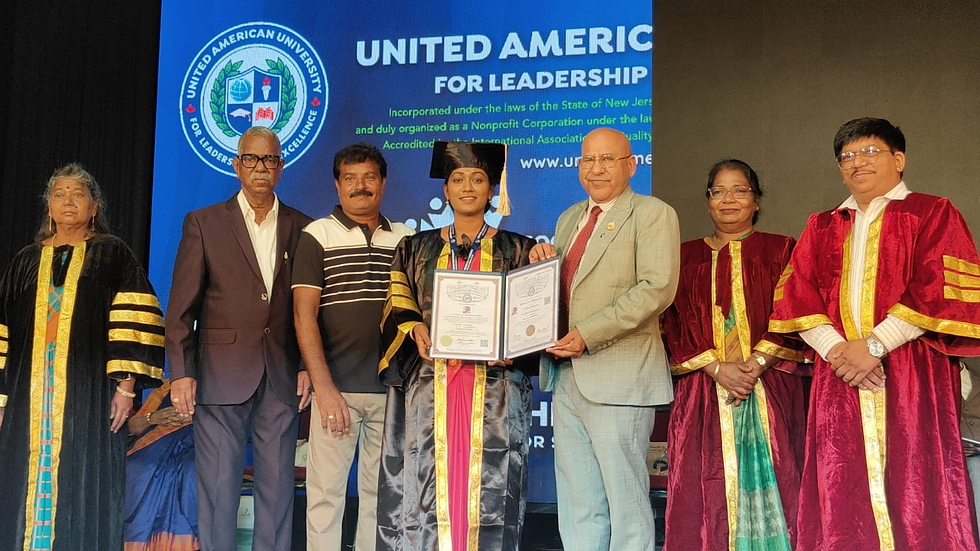
include an Honorary Doctorate – Doctor of Education (Honoris Causa) from the American University for Leadership and Excellence, Chennai, dated 17 May 2026, along with a Certificate of Recognition from the same institution. She has also been associated with the Ratan Tata Visionary Icon Award 2026 – Global Visionary Honour, the All India Women Excellence Award 2026 under the theme “Women Leader: Empowering Change, Inspiring Generations,” and the Star Awards 2026 – Best Social Service Award from Golden Entertainments, Coimbatore. Other recognitions listed in her profile include SIWAA 2026 – Certificate of Recognition in the category of Outstanding Leader, the Best IAS Academy Award 2026 from the TN Professional Educational Society and the Young Achievers Award 2026 from the Tamil Nadu State Council of Professional Education. Her profile additionally lists the Nari Shakti Awards 2026 – Inspiring Women Leadership Award. These recognitions span education, leadership, social service and women’s empowerment, reflecting the different areas in which Priya has been active. Nevertheless, the story of her achievements is not primarily a story about awards. The deeper significance lies in how she has used her own experience to influence the lives of others. Her journey began with a situation in which she was denied the opportunity to continue her education at the expected stage of life. Instead of allowing that experience to permanently define her, she reclaimed her education and subsequently created an organisation designed to make educational opportunities available to others. Her life therefore illustrates the transformative power of education in a particularly direct way. Her parents’ attitude towards education has also changed over time, adding another important dimension to her story. The same family that once stopped Priya’s education and married her while she was still in Class 10 now encourages families in their village not to marry girls before the age of 18 and instead to support their daughters’ education. Priya has described this change in mindset as one of her greatest sources of happiness. It represents a form of social change that cannot easily be measured through statistics or awards. Her own journey has influenced the attitudes of people closest to her and has contributed to a broader discussion about girls’ education and early marriage. This transformation demonstrates that social reform can sometimes begin with one person’s experience and gradually influence a family and community. Priya’s work with women, students and rural communities similarly reflects a commitment to practical empowerment. Whether she is helping an aspirant prepare for a government examination, providing a sewing machine to a widow, supporting the education of an underprivileged child or contributing land for a library, her objective remains consistent: to create opportunities through which individuals can become more capable of shaping their own futures. Her work is therefore best understood not as isolated acts of charity but as part of a larger educational and social philosophy. The growth of Avvaiyar IAS Academy provides the clearest example of this philosophy in action. Beginning with 73 students and eventually reaching more than 8,000 candidates, the academy has developed into a platform for competitive-examination preparation and student mentoring. The reported success of nearly 3,000 candidates in securing government employment illustrates the potential impact of accessible guidance and preparation. For Priya, each successful student represents an individual who has overcome barriers and moved closer to financial and professional independence. The significance of government employment is particularly strong for candidates from rural and economically disadvantaged families. A stable job can change not only an individual’s life but also the economic circumstances of an entire household. It can provide opportunities for younger siblings, improve access to education for children and reduce financial insecurity. Priya’s contribution therefore has consequences that extend beyond the immediate student. Her academy’s model also reflects the importance of inclusion in education. By offering free coaching to vulnerable groups and concessions to students from farming families, she has created a system that recognises that different students face different starting conditions. Equality in education does not always mean treating everyone identically; sometimes it requires providing additional support to those who face greater barriers. Priya’s initiatives are based on this understanding. Her professional identity as an educator is closely connected with her social-service activities. She does not separate teaching from community responsibility. Her work suggests that an educator can influence society not only through classroom instruction but also by helping students access opportunities, supporting families and strengthening community resources. The public library initiative, the support for underprivileged students and the women’s empowerment programme all reinforce this broader concept of education. Her own story also provides credibility to her motivational message. When Priya speaks about discipline, persistence and the importance of continuing one’s education, she does so as someone who has experienced educational disruption firsthand. She understands the frustration of having aspirations restricted by circumstances and the effort required to restart a journey after a setback. Her life therefore becomes part of the message she delivers to students. The central lesson is that a difficult beginning does not necessarily determine the final outcome. Priya’s journey is not one of effortless achievement. It involved financial hardship, interrupted schooling, early marriage, family resistance, work responsibilities and the challenge of pursuing education through distance learning. Her accomplishments emerged gradually through sustained effort. This makes her story relevant to students and young people who may feel that their own circumstances are preventing them from progressing. Her life shows that progress may sometimes require taking an unconventional route, returning to education later, balancing work and study or seeking opportunities outside traditional pathways. What distinguishes Priya’s journey is that she did not stop at personal achievement. After rebuilding her own educational and professional path, she chose to build pathways for others. That transition from survivor of educational barriers to creator of educational opportunities is the defining feature of her story. Today, her work encompasses competitive examination coaching, student mentoring, motivational speaking, women’s empowerment, rural education, community development and social service. Her guiding philosophy, “Empowering Minds, Transforming Lives, Building a Better Tomorrow,” is reflected in these activities. Her work demonstrates that empowerment is strongest when people are provided with the tools and opportunities needed to become independent. A sewing machine can become an income. A library can become a gateway to knowledge. Affordable coaching can become a government career. Educational support can allow a child to remain in school. Encouragement can help an aspirant continue preparing after repeated setbacks. Each initiative represents a different form of opportunity. The larger impact lies in how these opportunities accumulate across individuals and communities. S. Priya Natarajan’s story is ultimately a story of transformation. At 16, she was a student whose education was interrupted by circumstances beyond her control. Today, she is helping thousands of students pursue competitive careers and encouraging communities to recognise the importance of education. The contrast between those two stages of her life illustrates how profoundly persistence can change a person’s direction. Yet her greatest achievement may not be the qualifications she earned, the competitive examinations she cleared or the awards she received. It may be the decision to ensure that other young people do not have to experience the same loss of opportunity. Through Avvaiyar IAS Academy and her wider social initiatives, she has turned personal hardship into a commitment to public service. Her work with women, children, students and rural communities demonstrates a consistent belief that education and economic independence can provide people with greater control over their futures. Her journey from a farming family and an interrupted Class 10 education to becoming an educator, founder, mentor and social-service leader is therefore more than an individual success story. It is an example of how adversity can be transformed into purpose and how personal experience can become a source of social responsibility. Priya Natarajan’s continuing work stands on the idea that education should open doors rather than close them. By providing access, guidance, encouragement and practical support, she is helping others move through those doors. Her story demonstrates that the most meaningful form of success is often not reaching a destination alone, but making the path easier for those who follow. Priya Natarajan Padalur 6385853341


Enga priya mam...🙏🙏🙏🙏🙏🙏🙏🙏